
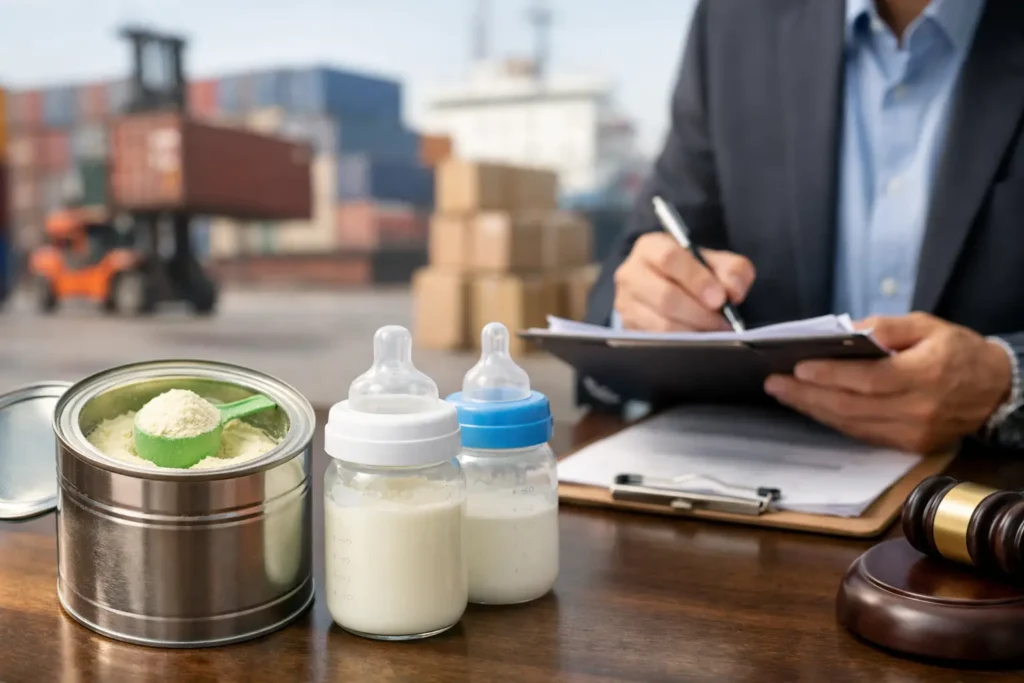
Customs Clearance for Baby Formula Imports

A container can arrive on schedule and still fail to reach your warehouse. For infant nutrition buyers, customs clearance for baby formula imports is not a final administrative step after procurement. It is a controlled part of the supply plan, affecting shelf availability, cash flow, product condition and the confidence of retail customers.
Baby formula is a highly regulated food category. Authorities may assess the product itself, its labelling, its manufacturer, its ingredients, its country of origin and the accuracy of the declared value. The exact route to clearance varies by destination market, but the commercial principle is consistent: prepare the file before the goods leave the supplier, not when the shipment is waiting at the port.
Why baby formula receives closer customs attention
Infant formula is intended for a vulnerable consumer group, so border authorities and food-safety agencies have little tolerance for vague product descriptions or incomplete paperwork. A declaration such as “milk powder” may be technically incomplete and commercially risky where the shipment consists of branded infant formula with a specific age stage, nutritional profile and retail presentation.
Formula may also be subject to food-import controls beyond standard customs entry requirements. Depending on the importing country, these can include prior notifications, importer registrations, facility or manufacturer details, health documentation, language-specific labels, ingredient restrictions and examination at the border. Organic, goat-milk, hydrolysed, anti-reflux, lactose-free and premature formulas can require particular care because their composition and claims may be assessed differently from standard products.
A hold does not necessarily mean the goods are non-compliant. It may simply mean an officer needs clarification. However, inspection time, port storage, demurrage and missed delivery slots can turn a correctable paperwork issue into an expensive stock interruption.
Start customs clearance for baby formula imports before purchase
The strongest clearance process begins with product selection. Before placing a pallet, mixed-load or container order, the importer should confirm that the intended stock can lawfully enter and be sold in the destination market. This is separate from confirming that a product is genuine, correctly manufactured and suitable for sale in its home market.
Check the formula stage, pack size, flavour or variant, ingredient list and front-of-pack claims against destination requirements. A European Aptamil, Nutrilon, HiPP Organic or SMA product may be authentic and traceable, yet still need market-specific label review or importer information before it can be distributed elsewhere. Do not assume that a product cleared on one previous shipment will be accepted unchanged forever. Regulatory requirements, tariff treatment and enforcement priorities can change.
The importer of record should also be agreed early. That party normally carries responsibility for the customs declaration, duties and taxes, regulatory filings and post-entry record keeping. A supplier can provide commercial and product evidence, while a customs broker can lodge declarations, but neither arrangement automatically transfers the importer’s legal responsibility.
Build a document pack that matches the physical goods
Clearance becomes much easier when every document tells the same story. Product names, quantities, batch references, net weights, country of origin, consignee details and values should match across the commercial invoice, packing list, transport document and customs declaration.
For a typical commercial formula shipment, the core pack commonly includes a commercial invoice, detailed packing list, transport document, proof of origin where relevant, product specifications and batch or lot traceability information. Destination rules may require additional food-safety certificates, health certificates, manufacturer declarations, import permits, prior-notice confirmations or organic documentation.
The precise document list depends on the route, product and local rules. That is why a buyer should ask its customs broker or regulatory adviser to review the proposed file before dispatch, especially for a new product line or first shipment into a market. A broker can only declare what it receives. Last-minute corrections often create the delay buyers hoped to avoid.
Product descriptions and tariff classification
The product description on the invoice must be clear enough for accurate classification. Include the brand, product type, stage where relevant, number of retail units, pack format and net weight. “Infant formula, Aptamil 1, 800 g tins” is more useful than “baby food”.
The correct commodity code determines duty treatment, statistical reporting and, in some markets, whether additional restrictions or licences apply. Formula classification can be affected by composition, milk content, intended use and preparation. Do not rely solely on a commodity code used for a different formula type, a different origin or an old shipment. Classification should be confirmed for the imported product and destination country.
Value and origin must be defensible
Customs value should reflect the actual transaction and any adjustments required under local valuation rules, such as freight, insurance, royalties or assists. Under-declaring a formula shipment may appear to reduce duty in the short term, but it can trigger reassessment, penalties, shipment holds and deeper scrutiny of future entries.
Origin is equally significant. It is not always the same as the country from which the lorry, vessel or aircraft departs. A formula supplied from a European warehouse may have a different manufacturing origin. Record this correctly and retain supporting evidence, particularly where preferential tariff treatment is claimed.
Labels, language and retail readiness
Customs release alone does not guarantee that cartons are ready for sale. Formula labels may need to show mandatory nutrition information, preparation instructions, allergen statements, age suitability, storage conditions, local responsible-party details and wording in the required language or languages.
This point matters for wholesale buyers managing fast-moving inventory. Relabelling after arrival can add cost and delay, while relabelling without proper controls creates a traceability risk. Where destination labelling differs from the European retail pack, decide before shipment whether compliant labels will be applied at source, in a controlled local facility or under another approved arrangement.
Outer cases deserve the same discipline. Carton marks should support warehouse receiving, batch control and customs inspection. If cases are mixed, the packing list must identify the contents clearly. A random inspection is far quicker when the relevant pallet, SKU and batch can be found without opening a large portion of the consignment.
Plan for inspections without losing control of the shipment
Even a well-prepared entry can be selected for documentary review, scanning, sampling or physical examination. Build this possibility into transit planning, especially for promotional stock, first orders and products with limited remaining shelf life.
Use a freight forwarder and broker experienced in food imports, and make sure they have a named contact who can answer questions quickly. Keep electronic copies of documents organised by shipment reference and retain evidence of all amendments. If an authority requests a certificate or clarification, response speed matters.
Temperature and storage conditions must also be protected while goods wait for release. Most powdered formula does not require chilled transport, but it still needs clean, dry handling and protection from excessive heat, moisture, odours and damaged packaging. Customs delays can expose weak logistics planning, particularly when goods are left at congested terminals without clear collection arrangements.
A practical pre-shipment clearance check
Before authorising collection, procurement teams should confirm the following points:
- The product is permitted for import and intended sale in the destination market.
- The importer of record, broker and regulatory contacts are confirmed.
- Commodity code, customs value and country of origin have been reviewed.
- Invoice, packing list, transport information and batch data match exactly.
- Required food, health, organic or import-control documents are available.
- Labels and outer cartons meet the destination market’s requirements.
This check is particularly valuable for mixed pallets and mixed containers. A single incomplete SKU can hold a broader shipment, so review every line rather than treating a container as one generic product.
Work with suppliers who support the clearance file
For B2B formula procurement, price per tin is only one part of landed cost. Buyers should also consider the quality of export packing, the availability of batch traceability, the accuracy of invoices and packing lists, the supplier’s ability to provide product documentation and its responsiveness when a broker asks a question.
A supplier with established European sourcing channels can help create a consistent document flow, but the buyer should state destination requirements before confirmation of order. Share the exact consignee name, delivery address, importer details, requested Incoterms, label expectations and broker instructions. Ambiguity at quotation stage tends to become cost at clearance stage.
Baby Formula EU supports professional buyers with export-ready packing, commercial documentation and traceability information for wholesale shipments. For repeat programmes, agreeing a standard documentation checklist with the supplier, broker and receiving warehouse can reduce avoidable variation from one order to the next.
The best outcome is not simply a shipment that clears customs. It is stock that reaches the warehouse with its paperwork, batches, labels and commercial records ready for confident onward distribution.