
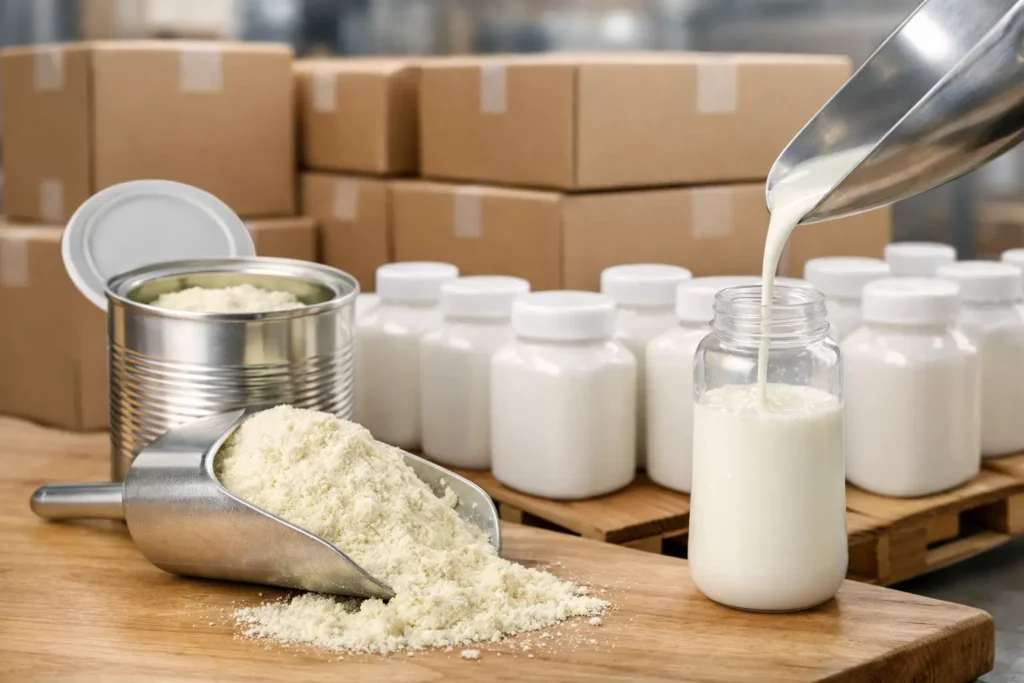
Lactose Free Formula Bulk Orders for Trade

A delayed specialist-formula shipment does more than leave an empty shelf. It can force pharmacies, retailers and distributors to disappoint families who rely on a specific nutritional option. For professional buyers, lactose free formula bulk orders need the same commercial discipline as any high-turnover infant nutrition line, with closer attention to product specifications, batch management and local import requirements.
Lactose-free products are not interchangeable with comfort, anti-reflux, hydrolysed or dairy-free formulas. A purchasing decision based on an unclear product description can create a costly mismatch between the product received, the market need and the approved local listing. The strongest buying process starts before a quotation is requested: define the exact product requirement, the route to market and the documentation your destination expects.
Why lactose-free formula needs careful procurement
Lactose-free formula is generally purchased for a defined nutritional need rather than as a broad lifestyle category. Demand may be steadier through pharmacy channels, paediatric nutrition retailers and specialist e-commerce shops, but it can also be less predictable than standard first infant formula. This affects how buyers should plan stock, select pack formats and set reorder points.
The commercial objective is not simply to obtain the lowest unit price. It is to secure recognised, genuine product with usable shelf life, consistent labelling, traceable batches and a delivery plan that keeps stock available without tying up unnecessary capital. A low quotation becomes less attractive if it leaves too little remaining shelf life for distribution, clearance and retail sell-through.
Product positioning also varies by brand and destination market. Some lactose-free formulas are designed for infants from birth, while others are intended for a particular age range or feeding stage. Buyers should never assume that a familiar brand name means identical formulation, pack size or label language across every European market.
Build the product specification before requesting a quote
A clear specification turns a general enquiry into an order that can be checked, packed and exported accurately. Begin with the brand, exact product name, stage, format and preferred sourcing market. State whether the order requires tins, ready-to-feed packs, cartons or another presentation, as well as the target pack size and outer-case configuration.
It is useful to set out the commercial requirements alongside the product details. Confirm the destination country, estimated volume, preferred Incoterm where applicable, required shelf-life threshold on arrival and whether mixed pallets or mixed loads are acceptable. This gives a wholesale supplier the information needed to assess availability and recommend a practical loading plan.
Do not treat similar speciality formulas as substitutes
A lactose-free formula may sit close to comfort, sensitive or partially hydrolysed products in a catalogue, but its nutritional purpose and ingredient profile are different. Substitution should only be considered when it has been reviewed by the buyer’s regulatory, quality and commercial teams. A supplier can clarify the product identity and available variants, but the importer remains responsible for ensuring that the item is appropriate for its intended market and sales channel.
This is particularly relevant for online retailers. Product titles, images and descriptions must match the physical stock and local compliance position. Listing an unsuitable alternative as lactose-free can lead to customer complaints, returns and reputational damage that outweigh any short-term inventory benefit.
Lactose free formula bulk orders: choose the right volume
There is no universal minimum that suits every buyer. A pallet order can be a sensible starting point for a new market, a new product line or a pharmacy-led programme with measured demand. It allows the buyer to test sell-through and delivery performance while keeping the product range focused.
Established distributors and supermarket groups may benefit from mixed loads or full-container planning when demand is proven. Larger volumes can improve freight efficiency and reduce handling cost per unit, yet they also increase exposure to expiry risk, currency movement and changes in local demand. The right order size depends on average monthly sales, lead time, clearance time, warehouse capacity and the stock buffer required for service continuity.
A useful planning approach is to work backwards from the desired stock cover at arrival. Add expected production or collection time, export preparation, sea or road transit, customs clearance and delivery to your warehouse. Then allow a realistic contingency for inspections, port congestion or document queries. Speciality nutrition stock should not be planned on an ideal transit schedule alone.
For mixed loads, buyers should consider whether lactose-free stock belongs with complementary fast-moving lines from the same range. Combining specialist products with core infant, follow-on or toddler formula can make a shipment more commercially balanced, provided each item has a clear sales route and the outer packaging can be handled correctly at destination.
Protect authenticity, condition and traceability
Infant nutrition is a category where product confidence is central to every commercial relationship. Buyers should expect traceable batch information, clear product identification and packaging that is suitable for international handling. Batch records help with warehouse control, retailer queries and any necessary market action, while intact packaging protects product presentation at the point of sale.
Before confirming an order, agree what evidence will be available for the consignment. This may include packing information, batch and expiry details, product photographs where required, and the commercial documents needed by the importer. Requirements differ by market and shipment, so it is better to identify the document set before goods are loaded rather than attempt to correct omissions once the consignment is in transit.
European sourcing can offer professional buyers access to established brands and recognised product ranges. However, sourcing alone does not remove the need for controls. Check the label language, country-of-origin information where relevant, local registration rules, permitted claims and importer obligations for the destination market.
Documentation and export preparation matter as much as stock
A shipment can be physically ready and still miss its planned departure because a commercial invoice, packing list or customs detail is incomplete. For lactose-free formula, documentation accuracy is especially valuable because buyers may be supplying regulated retail, pharmacy or healthcare-adjacent channels with strict receiving procedures.
The required paperwork will depend on the destination, shipment value, transport method and importer status. Professional buyers should confirm their requirements for invoices, packing lists, certificates, product data, origin-related documents and any customs-support materials well before collection. They should also verify the exact consignee details, commodity classification used by their customs adviser and whether the destination has specific labelling or pre-notification requirements.
Good export preparation is not about generating paperwork for its own sake. It reduces the risk of avoidable clearance delays, demurrage charges and stock arriving after a retailer’s promotional window has passed. It also gives the receiving team a cleaner record for warehouse intake and onward distribution.
Plan logistics around product protection
Formula should be transported and stored according to the manufacturer’s handling guidance. Buyers need to consider ambient conditions, warehouse cleanliness, pallet stability and protection from moisture, crushing and excessive heat. A shipment that arrives on time but with compromised outer cases can still create losses at goods-in.
Select a transport plan that matches the order size and destination. Road freight may be appropriate for certain European routes, while sea freight often suits larger export volumes. Air freight can solve an urgent supply problem, but its cost rarely makes sense as a standard replenishment model for bulky, value-sensitive formula stock.
Confirm who is responsible for collection, export clearance, freight booking, insurance and final delivery. The handover points should be understood by both parties. Clear responsibility prevents the familiar problem of goods waiting at a warehouse because each side assumed the other had arranged the next step.
Turn one order into a dependable supply programme
The first successful shipment should create better data for the next one. Track sales by SKU, sell-through by channel, remaining shelf life at receipt, landed cost, damage rates and actual transit time. These figures are more useful than a broad estimate when deciding whether to increase volume or keep a specialist line on a measured replenishment cycle.
It also helps to share a rolling forecast with the supplier, particularly for recognised brands and speciality formulas where availability can vary. A forecast is not necessarily a binding purchase commitment, but it gives both sides a clearer view of upcoming requirements and helps reduce last-minute buying pressure.
Baby Formula EU supports professional buyers with bulk ordering structures from pallet quantities and mixed loads to full-container shipments, alongside export-ready packing and commercial documentation support. The practical value is a more organised route from product enquiry to shipment, without adding unnecessary complexity to procurement.
Questions to settle before issuing the purchase order
Before the order is released, make sure the product identity, volume and delivery plan are agreed in writing. The following points prevent most avoidable misunderstandings:
- Exact brand, product name, stage, pack size, format and source-market version.
- Quantity by SKU, cases per pallet, pallet count and whether mixed loading is permitted.
- Minimum acceptable remaining shelf life at dispatch or arrival.
- Required documents, label expectations and destination-market compliance responsibilities.
- Collection date, transport method, Incoterm, payment terms and the party responsible at each logistics handover.
A dependable supply programme is built through accurate specifications and realistic lead times, not rushed ordering. When lactose-free stock is planned early, documented correctly and matched to a genuine market need, buyers can protect availability for their customers while keeping inventory and landed costs under control.